As part of the new EU4MEDTECH Explains series, we are taking a closer look at some of the key terminology and concepts shaping the European Medical Device (MD) and In Vitro Diagnostic Medical Device (IVD) regulatory landscape.
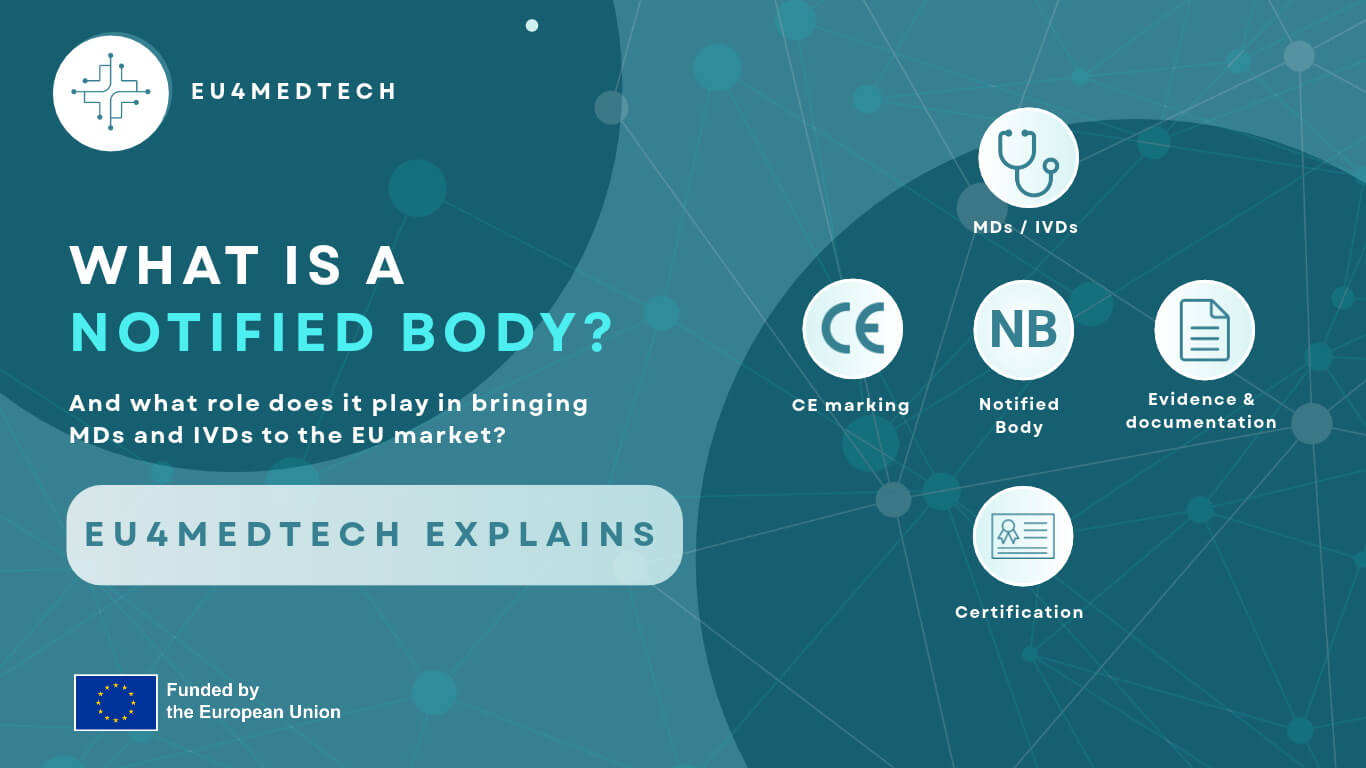
We begin with one of its key actors: the Notified Body (NB). But what exactly is a NB, and what role does it play in bringing medical technologies to the EU market?
A NB is an independent organisation designated by an EU Member State, or by another country under specific agreements, to carry out conformity assessment activities for certain products before they can be placed on the market. For MDs and IVDs, NBs assess whether products meet the applicable requirements of the MDR and the IVDR whenever third-party conformity assessment is required.
Not every MD or IVD needs an NB, but where one is required, it plays a central role on the regulatory pathway to market access.
So, how does an organisation become a NB? The designation comes with extensive requirements. A candidate organisation must first demonstrate that it has the right organisational structure, quality management system, resources, expertise and processes in place. Its competence is then assessed through a designation process led by the responsible national authorities, with the involvement of European experts.
Are all Notified Bodies the same?
Not quite. Each NB is designated for a specific scope of activities and types of devices, meaning that it can only carry out conformity assessments in the areas covered by its designation. Manufacturers therefore need to work with a NB whose scope matches the relevant device and conformity assessment procedure.
The main public reference point for designated Notified Bodies and their areas of designation is the European Commission’s NANDO (New Approach Notified and Designated Organisations) information system.
What does a Notified Body assess?
The scope of the assessment depends on the device and the applicable conformity assessment route. Depending on these factors, a NB may review:
- technical documentation;
- clinical or performance evidence;
- risk management documentation;
- quality management systems; and
- compliance with applicable MDR or IVDR requirements.
This assessment provides an independent check that the applicable regulatory requirements have been met. Where NB involvement is required, successful conformity assessment and certification allow the manufacturer to proceed towards CE marking and placing the device on the EU market.
Why does this matter for EU4MEDTECH?
The transition to the MDR and IVDR has introduced new requirements and demands across the European MedTech regulatory ecosystem. Increased workloads and limited availability among NBs and other regulatory actors have been identified among the factors contributing to challenges related to certification and market access.
EU4MEDTECH is addressing this broader context by developing a life cycle-oriented framework for the generation and evaluation of clinical and performance evidence for high-risk and innovative MDs and IVDs, together with a digital platform designed to operationalise these approaches.
This is where NBs become especially relevant to the project. Beyond their role within the regulatory environment, they bring valuable perspective and practical experience, which directly supports the development and validation of project solutions. Other stakeholders from the MedTech ecosystem are also involved in the journey, ensuring that the framework and digital platform respond to real-world needs in the generation and evaluation of clinical and performance evidence.